

How Transportation Management Systems Support Energy Trading and Risk Management
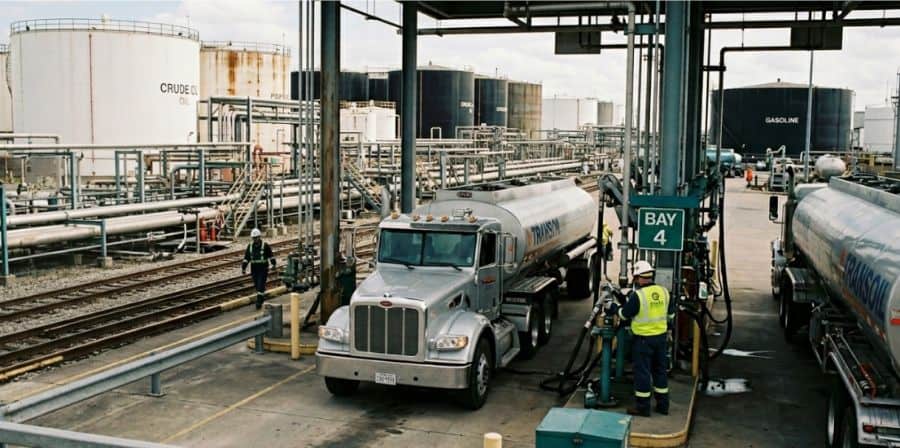
Transportation management systems give energy traders a clear, current picture of where their physical product is moving, which is not always easy. U.S. energy markets keep shifting under the weight of price volatility, demand swings, and growing appetite for commodities like natural gas and LNG. At the same time, midstream operators have to coordinate supply and demand with the physical movement of crude, gas, NGLs, finished fuels, and refined products across truck, rail, pipeline, and barge. It’s a choreographed dance with a lot of moving parts.
A single hydraulic fracturing job can burn through roughly a million gallons of diesel, and margins on that fuel are thin enough that a small miscalculation turns into a real loss. Pulling field, logistics, and accounting data into one platform is what keeps commercial, operations, and finance teams working from the same numbers.
What Energy Trading and Risk Management Means in Oil and Gas
Energy trading and risk management (ETRM) covers the digital systems and processes companies use to execute trades, move commodities, and stay compliant with regulatory and tax requirements. Gartner, a leading technology, research and consulting company, offers a well-rounded definition for ETRM:
ETRM involves commercial decision making and market execution using an integrated system that enables data exchanges among trade floor, operations, credit, contract and accounting functions. Integral to the process are event and trade identification/capture, comprehensive risk management strategies/policies, scheduling/nomination/transportation, and settlement execution. The process also provides for price transparency, market monitoring, controlled access, and regulatory compliance.
Those in the business of selling finished fuels and refined products often feel like their organization is in the banking business. That’s because paper-based transactions, inconsistent routing of tickets from operations, and manual workflows delay accounts receivable invoices by months, which can feel like the seller is continuously lending money to buyers. Given the volume of transactions involved, teams can be out millions at any given time, underscoring the need for robust accounting processes that work in parallel with the logistical complexities of energy trading.
Why Physical Commodity Logistics Drive Trading Outcomes
Unlike contracts that are traded on the major commodity exchanges – like natural gas and crude oil – suppliers of finished fuels and refined products take physical custody of these commodities. That puts these traders in the transportation business, requiring companies to manage fleets of trucks and drivers in parallel with the back office and trading operations. As a result, a trade is only as good as the logistics behind it. Transportation fees, fuel losses, quality adjustments, demurrage, and storage costs all chip away at the margin that looked clean on paper. Demurrage alone can be a serious drag, with trucks sitting in line at loading docks while the meter runs. Traders who see these factors as they happen can adjust their positions, while those working from delayed reports tend to find out about the damage well after the money has left the building. The physical side of the business also shapes optionality. Real-time visibility into prices and inventory at both origin and destination lets shippers react quickly when markets move, reroute loads when a plant goes down, and schedule just-in-time pickups so trucks are not idling on the clock. Logistics is where a paper trade becomes a real one.
How Transportation Visibility Reduces Risk in Energy Markets
Visibility is the single biggest lever for reducing settlement and market risk. When measurement data flows directly into a transportation accounting system, discrepancies show up quickly and can be addressed before they compound. Customer disputes drop because the numbers on an invoice can be traced back to the original volume, the contract formula, and the fees applied. Imbalances become easier to manage because operators can see them building in near real time rather than discovering them a month later.
Better visibility also helps risk teams model exposure more accurately. When you know exactly what moved, when it moved, and under what terms, hedging decisions get sharper and credit exposure to individual counterparties is easier to track. For companies selling finished fuels and refined products, the same real-time feed supports physical position reporting, DOT compliance, International Fuel Tax Agreement (IFTA) filings for cross-state trucking, electronic logging device (ELD) data for driver utilization, and the weighted-average pricing work that traders rely on to time loads correctly.
Traders constantly watch rack and index prices from sources like OPIS and DTN, forecast monthly and annual averages, and decide when to load from the yard, pick up from the rack, stockpile, hold, or sell. Getting those calls right depends on having current data, not yesterday’s snapshot.
The Role of Transportation Management Systems in Commodity Trading
A transportation management system acts as the connective tissue between the physical network and the commercial side of the business. It captures volumes, applies contract terms, calculates fees, and produces the invoices that settle each month. For commodity trading groups, the same system can feed scheduling and deal capture with accurate, current data. When traders, schedulers, and accountants share one source of truth, the business avoids the expensive problem of having three different teams working from three different numbers.
How Digital Logistics Platforms Connect Trading, Accounting, and Operations
Modern digital platforms break down the walls between departments that used to work in isolation. Trading desks, operations teams, accounting groups, and risk managers all touch the same data model, so a change in one place flows through to the others automatically. Paper field tickets and disconnected systems have long held back cash flow because invoices sit waiting for data that never quite makes it to the general ledger. A unified platform pulls transaction capture, market and rack pricing, AR, and regulatory reporting into one environment, which shortens the time between a load leaving a terminal and a customer being invoiced. Predictive inventory also gets easier, because the same data feed that drives accounting can warn dispatchers that a tank is filling faster than expected and that a truck needs to roll sooner. The platform makes logistics, commercial activity, and financial reporting move in sync.
How W Energy Connects Transportation Data With Energy Trading Workflows
Combining a mobile app for drivers and a comprehensive back office suite for dispatch, inventory management, accounting, and deal capture, W Energy’s transportation management system can be deployed in just weeks and at a fraction of the cost of “big box” solutions. The cloud-based solution automatically captures transactions and incorporates real time index data and rack prices into cloud-based deal movement screens, enabling energy trading and risk management teams to instantly view supplier and customer pricing, KPIs (e.g., run time, drive time, load/unload time), and margin calculations.
The TMS solution provides traders with the robust transportation management capabilities needed to manage shipments by truck as well as modern ETRM technology to gain unprecedented visibility into high volume transactions, enabling organizations to increase business performance and deal volume. Importantly, W Energy’s transportation management system is the only solution that provides seamless integration with a traders core financials, accelerating accounts receivable and cash flow while mitigating risks with automatically generated physical position reports, including IFTA.
W Energy Software’s TMS enables continuous, real time communications with all available transporters, allowing the back office to choreograph the “big dance” of oilfield transportation and ensure the fluid movement of trucks and the disposition of commodities at any given time. The real time communications unlocked by the cloud and mobile devices are also enabling predictive inventory – both long and short – at storage locations, virtually eliminating costly demurrage fees for trucking.
In oilfield transportation, not everything goes as planned, underscoring the need for carriers, dispatchers, and suppliers to collaborate around a wide variety of data to adapt plans and keep moving. The TMS solution eliminates data silos by integrating transportation contracts and commodity price feeds from price indexes in context with traffic and weather data. Additionally, with real time visibility into prices at origin and destination locations, W Energy Software’s TMS provides shippers with increased optionality and enables rapid response to supply chain anomalies, increasing agility and improving margins.
Request a demo today to see how our team can help connect your transportation data with the commercial and trading workflows that depend on it.