

Modernize Midstream Accounting: A Complete Guide to Replacing Legacy Software
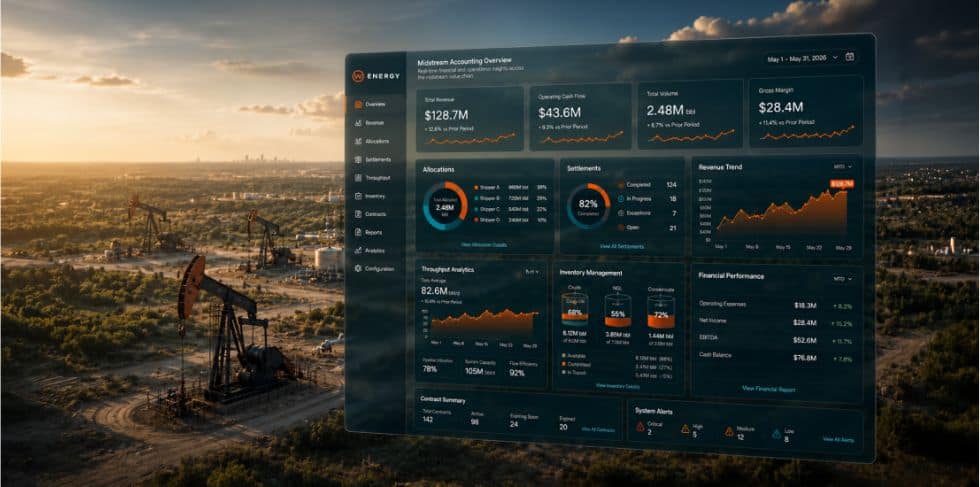
Legacy midstream accounting software should be replaced when it slows your month-end close, hides how calculations are made, forces your team into spreadsheet workarounds, or charges steep fees for upgrades that add little value. Modern, cloud-based platforms solve these problems by unifying workflows, making every calculation traceable, and running settlements and allocations in minutes instead of hours.
Why Legacy Systems No Longer Work
Plenty of oil and gas companies are still running midstream accounting software that was built twenty or thirty years ago, well before the cloud or the shale boom. The complaints tend to be the same from one company to the next. Accountants can’t see how the numbers were calculated, the screens look like something out of the 1990s, and because the different tools were never built to share data, kicking off a single process can tie up a machine for hours.
The root cause is a business model that favors acquisition over innovation. Rather than rebuild aging products, legacy vendors bolt new features onto outdated code or buy other software companies, which creates loosely connected tools and data silos. A single midstream operator might run separate packages for plant accounting, division order, disbursement, contract management, and gathering, each built by a different team at a different time. The result is restricted data flow, repeated manual entry of the same records across modules, and reporting that struggles to answer basic questions.
Slow speed adds to the issue. Some operators have had to set a middle-of-the-night alarm just to start an allocation or settlement run, only to find hours later that the process failed and needed a rerun. Software tied to on-premise servers is limited by local hardware, and inefficient database design makes calculation-heavy work even slower.
The Hidden Costs of Excel Workarounds
When accountants lose trust in their system, they turn to spreadsheets to validate results or perform tasks the software can’t handle. For instance, one midstream operator in Denver was settling entire plants in Excel because they didn’t trust their legacy software. In another case, a large Permian midstream company relied on nearly 100 spreadsheets before switching. The hidden costs add up quickly.
Multiple Versions of the Truth
With accounting data scattered across hundreds of spreadsheets, companies create competing versions of their financial reality. When an internal review or external audit arrives, reconciling those copies becomes a scramble, and a lack of transparency into the underlying calculations raises real compliance risk.
Manual Calculations and Human Error
Verifying high-volume transactions by hand invites mistakes. Inflation rates, escalation schedules, fixed recoveries, minimum volume commitments, deficiency invoices, cumulative imbalances, prior period adjustments, and tier-based fee or POP percentages all get recalculated outside the system, where a single error can ripple into the general ledger.
Spreadsheet Maintenance Overhead
Maintaining what can be hundreds of separate spreadsheets carries its own cost in time, training, and knowledge transfer. When the employee who built a critical model leaves, that institutional knowledge can end up leaving with them.
Key Benefits of Replacing Your Legacy Midstream Accounting Software
Moving to a modern, purpose-built platform delivers gains across every part of the accounting workflow.
Confidence in Calculations and Data
A calculation trace feature gives users step-by-step visibility into how settlement values, taxes, accounting results, and owner disbursements are derived. W Energy’s CalcTrace lets users and auditors backtrace results from gas statements all the way to accounts receivable and payable, and many teams send a CalcTrace screen shot as defensible documentation to customers who ask how their fees were calculated.
A Unified, Cloud-Based Platform
When core workflows share one common dataset, applications integrate naturally and eliminate data silos. Plant accounting, division order, contract management, and gathering all live in one system, so teams stop shuffling data between disconnected tools and stop recreating the same record in three places.
Painless Upgrades
A modern vendor refines the product continuously and delivers new releases through a one-click upgrade that is tested against your own data first. Enhancements built over the year, including new functionality, additional interfaces, and faster processes, roll into each annual release at no added cost, a sharp contrast with legacy vendors who charge near-implementation prices for interface tweaks.
Simplified Compliance
From GAAP and Sarbanes-Oxley (SOX) to ASC 606 revenue recognition, midstream companies face layered internal controls and regulations. Flexible GL mapping at the contract level supports accurate revenue recognition, and out-of-the-box state regulatory reporting removes the time and risk of manual filing preparation.
Faster Processing
Cloud architecture built to harness on-demand computing power runs settlements and complex allocations in seconds rather than hours. In some instances, it can be up to 150 times faster than older tools. Faster runs mean accountants can validate results before statements go out, which reduces prior period adjustments.
What to Look For in a Modern Midstream Accounting Platform
Not every replacement is an upgrade. When you evaluate midstream accounting software, weigh these capabilities before you commit.
Calculation Transparency
Look for a clear audit trail that shows how each variable in a formula produced a result. Transparency builds trust with partners and turns dispute resolution into a quick lookup rather than a fire drill.
Integration Across Workflows
Choose a platform where measurement, gathering, division order, AFE, revenue, and financials connect on a shared dataset. Native integration reduces manual entry and keeps volume and financial data reconciled.
Upgrades and Support Without Surprise Costs
Favor an all-inclusive licensing model that includes upgrades, support, and training. You should never have to pay extra for a support tier or for enhancements developed for another client.
Built-In Regulatory Reporting
A platform with embedded state regulatory reports and continuously updated GAAP standards keeps compliance inside your financial tools instead of pushing it back into spreadsheets.
Cloud-Powered Speed and Scale
Confirm the system runs in the cloud and scales as your asset portfolio grows, so processing times shrink even as your transaction volume rises.
How W Energy Supports a Smooth Transition from Legacy to Modern Software
W Energy’s Midstream Plant Accounting Solution was purpose-built to address legacy software gaps. Our innovative platform combines transparent CalcTrace calculations, a unified cloud architecture, one-click upgrades, built-in compliance tools, and processing speeds that close month-end in hours or minutes. Before any new release reaches your team, W Energy tests it against a copy of your database, and customers move off dozens of spreadsheets onto a single source of truth. One senior revenue accountant reported spending 50% less time on their most complicated assets after the switch.
Request a demo to see how much time your team could reclaim with W Energy’s midstream accounting solution.
Resources:
www.strausscenter.org/energy-and-security-project/the-u-s-shale-revolution/