

How to Modernize Land Management for Stronger Cash Flow and Lower Risk
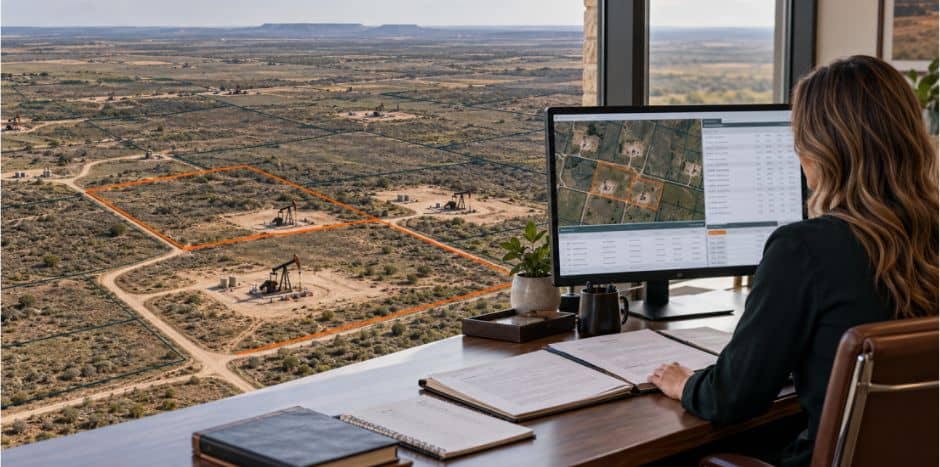
Modernizing land management starts with one practical change. Replace spreadsheets and disconnected point tools with integrated oil and gas land management software that connects lease data to financials, tracks every obligation automatically, and gives your team a live view of acreage. That single shift protects leases, speeds acquisitions and divestitures, and frees up cash flow, all without adding G&A.
For upstream operators, land is the physical record of what you own, what you owe and where the next well can go. When that record lives in scattered files and manual workflows, decisions slow down, and risk climbs.
The State of Land Management in Oil & Gas Today
Land leaders carry more weight than ever. Free cash flow now matters more to investors than raw production growth, so every acreage decision gets scrutinized for its return. Yet many land teams still work in a reactive mode, where daily calls about what to develop and where to drill get clouded by poor data access, huge lease volumes, and manual processes.
The pressure only grows during deals. Upstream M&A has reached record levels of consolidation, with roughly $250 billion in transaction value over a recent 12-month stretch. When a company cannot quickly show what it owns, the interest it holds, and its obligation schedule, value slips away in evaluation. Renewables add another layer, since wind, solar, and geothermal projects bring lease and contract complexity that land teams now manage alongside oil and gas.
Why Legacy Tools are Costing You Cash Flow
Spreadsheets and one-off approaches feel safe because they’ve been around forever, but in practice, they leak money. A missed lease payment can trigger costly litigation when a landowner asks why a renewal check never arrived. Overpaying interest owners to sidestep the hassle of decoding royalty provisions drains revenue month after month.
An oil and gas company running around 1,500 wells overspends about $1 million a year on software licenses and pays roughly 10 full-time employees to move data between systems and troubleshoot daily issues. Brittle vendor integrations add cost without fixing the core problem, one of the warning signs that legacy software
is holding an operation back.
What Modern Land Teams Need to Succeed
The right toolkit lets a lean team do more, react less, and plan ahead.
A Single Source of Truth
When land, lease, division order, and revenue data share one system, everyone works fron the same numbers, with no reconciling multiple versions of a leasehold or chasing the current record across departments. Audits and A&D reviews get easier, too.
Automated Obligation Tracking
An auto-generated calendar of payment and non-payment obligations, agreement expirations, and key dates keeps assets safe without manual upkeep, with color-coded daily views showing what needs attention this week versus next quarter. Because it builds itself from your lease data, no renewal slips through when someone is out of the office.
GIS and Financial Integration
Mapping tracts, wells, pipelines, and competitor acreage visually helps teams plan drilling programs with confidence and spot gaps early. Tying land data directly to financials removes the check-request shuffle between departments, so payments stay on schedule.
Fast Access to Big Data
Importing tens of thousands of contracts and folding them into workflows in hours rather than days lets teams monitor acreage by exception. Rather than answering one-off questions, a modern system keeps watching for changes in royalties, leases held by production, and obligations, so teams act only when needed.
Key Areas to Drive Productivity and Reduce G&A
A modern platform pays off fastest in a few specific places.
Confidently Meeting Royalty Obligations
Ownership splits from inheritance, add-on acquisitions, lease renegotiations, and cost-free provisions make royalty math a daily challenge. Track those provisions accurately, and you pay interest owners correctly the first time, which protects revenue and keeps partner relationships clean.
Mining Inventory for Best Wellsites
With Wall Street rewarding free cash flow over aggressive growth, rig placement has to be deliberate. Sort shifting drilling obligations to surface leases with in-pay penalties, so you plan around the leases that most need action and never lose acreage ahead of the drill bit.
Accelerating Acquisitions and Divestitures
Deal data usually arrives as boxes of documents of thumb drives full of PDFs, and sampling a fraction of it leaves real risk on the table. Search an entire data package quickly to answer buyer questions, verify quality, and move faster than competitors. On the sell side, clean answers signal there are no surprises in the leasehold, which makes assets more marketable.
Growing the Bottom Line Without Growing G&A
Adding acreage and revenue without scaling headcount comes down to productivity. Automate lease analysis and workflows so a smaller team can cover more ground, freeing the team for higher-value work while holding G&A steady. The same principle extends to the field, where optimizing the wells you already operate boosts cash flow without new drilling.
Why W Energy Leads in Land Management Innovation
W Energy built its upstream land solution as part of a single, cloud-based SaaS ERP, so lease administration connects natively to division order, revenue accounting, and disbursement. Teams get custom acreage calculations, an automated E-Calendar, ESRI ArcGIS integration, and support for any agreement type, from oil and gas leases to wind, solar, and geothermal contracts. The payoff is fewer missed obligations, cleaner deal data, and a land department that runs lean while protecting cash flow.
Request a demo to see how integrated oil and gas land management can benefit your team.
CTA Button: Download the whitepaper now!