

Why It’s Time to Replace Legacy Midstream Accounting Software
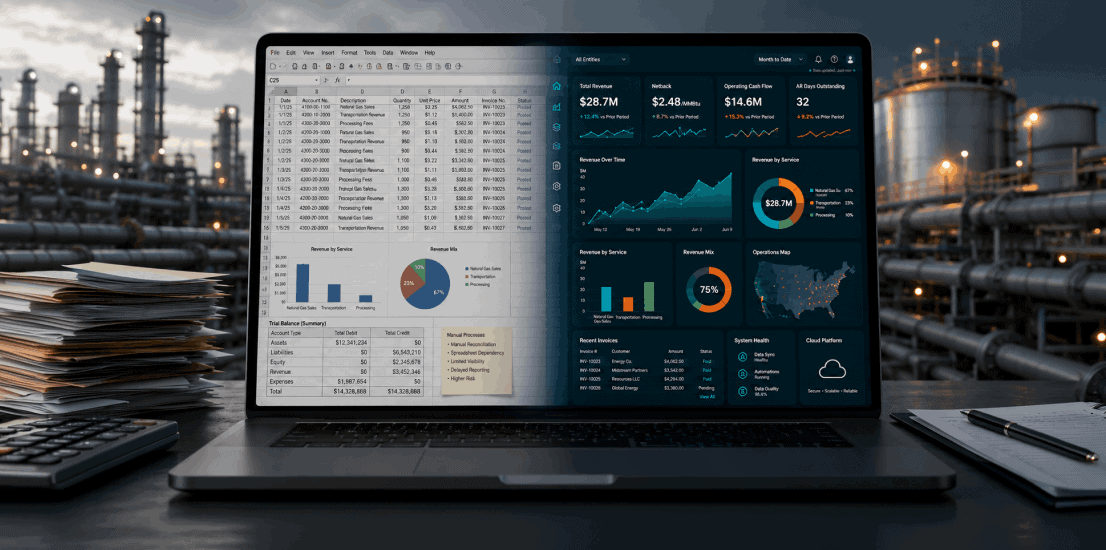
Legacy midstream accounting software should be replaced when it hides how calculations are made, forces your team into Excel workarounds to validate results, and runs on aging on-premise technology that cannot keep up with how midstream companies operate today. Modern, cloud-native accounting platforms solve these problems directly by exposing every step of a calculation, connecting disconnected systems into one shared dataset, and giving accountants confidence in the numbers they post. If your team spends more time validating software output than acting on it, the cost of staying on a legacy system has already outgrown the cost of switching.
The Growing Cost of Outdated Midstream Systems
In midstream accounting, precision and transparency are everything. Legacy software undermines both, and the price shows up across time, money, and risk. When oil and gas accountants cannot see how a result was produced, they rebuild the math somewhere else to check it. We have seen clients run calculations in Excel every month simply to validate what their accounting software already produced. That duplicated effort places an unnecessary burden on staff, introduces the risk of human error, and adds real expense in hours and resources.
The hidden costs compound quickly. One recent client, a large Permian midstream company, previously relied on close to 100 spreadsheets to support workflows that their legacy plant accounting solution could not handle on its own. Another company in Denver came to us wanting to leave a common legacy platform, and during onboarding, we learned they were settling their plants entirely in Excel because they did not trust the software they had paid for.
Each of those spreadsheets carries maintenance overhead, creates audit headaches, and pulls financial data outside the system of record, which puts compliance at risk. Time spent waiting on results, routing requests through IT, and reconciling numbers by hand all translate directly into cost. After moving to a unified platform, that Permian client now saves thousands of dollars through reduced processing time, lower audit costs, less knowledge transfer, and a better total cost of ownership.
The Challenges of Legacy Midstream Accounting Platforms
The root problems with legacy midstream accounting software tend to fall into a few recurring categories. Understanding them makes it easier to evaluate whether your current system is holding your team back.
Limited Data Transparency
Many accounting packages behave like a black box, giving accountants little visibility into how calculations and allocations were performed or how results were created. Those systems are typically built on older architecture, which limits calculation and allocation options and pushes work off-system into tools like Excel. A vendor can refresh the look and feel of old software, but if the underlying data architecture does not change, it remains impossible to show how the system performs critical calculations. The predictable result is that users stop trusting the output and start checking it manually.
An Outdated User Experience
Legacy accounting software does not just look old, it feels old. Accountants describe antiquated prompt screens and the frustration of relying on the IT department just to find data or download results. Software designed to fit a 15-inch monitor three decades ago looks poor on a modern widescreen display and slows people down at every click. Access is another pain point, because legacy solutions were built for the era of on-premise deployment. With remote and hybrid work now standard, having to go into the office because the software cannot be reached from home should be a relic of the past. Some vendors have tried to bolt a new interface onto old code, but without changing the foundation, they still cannot help users understand a calculation or the impact of a setup change.
Disconnected, Siloed Systems
Midstream companies frequently run several separate systems to operate the business. A
single company might use one package for plant accounting and others for division orders and disbursement, contract management, gathering, and financial accounting. In nearly every case, those products were built with different technologies, at different times, by different development teams, sometimes even when they come from the same vendor. Each difference translates into poor or nonexistent integration, restricted data flow, and reporting gaps. Teams end up shuffling data between systems, learning multiple interfaces, and recreating the same data object in three different modules.
Forced Reliance on Excel
Companies invest in accounting software, yet users still fall back on Excel because of system limitations, a lack of transparency, or simple distrust of the results. Spreadsheets become the place where teams handle the work the software cannot, including inflation rates, escalation schedules, fixed recoveries and ethane recovery-to-rejection changes, minimum volume commitments, deficiency invoices, cumulative imbalances, prior period adjustments, tier-based fees and POP percentages, contract terms and dedications, and ASC 606 revenue recognition. Manually verifying high-volume transactions invites error, and working with financial data outside the ERP creates a compliance exposure that auditors do not appreciate.
How Modern Midstream Software Delivers the Visibility and Confidence Teams Need
Modern accounting software gives professionals complete confidence in their data, and that starts with transparency. W Energy provides enhanced insight into accounting data and results through user-friendly reporting, configurable grid views that export with a click, and full audit trails. A standout capability is Calculation Trace (CalcTrace), our proprietary technology algorithm that provides a clear, defensible, breakdown of shows every step and variable behind a result. Want to see how a value of ethane was calculated, including percent-of-proceeds percentages based on tiered GPMs and the greater of two index prices? You can. Want to follow a treating fee that takes five cents per CO2 mol percent above the tolerance and then escalates on CPI with a 3 percent annual cap? That traces cleanly too. Users and auditors can follow any value posted to the general ledger back through every preceding stage and calculation.
Understanding the impact of a change matters just as much. Our Association Graph lets users see where an object is used elsewhere in the system at any moment. You can check whether a meter is tied to a contract, lives in an allocation group, or carries volumes and analyses. You can see which contracts a residue price feeds before you edit it, which rates use a given escalation, or which contracts use a particular formula. Knowing what you are changing and what it touches helps prevent prior period adjustments (PPAs) and gives you confidence in your results. Manual workarounds and guessing at how a calculation happened belong in the past.
The Power of a Unified, Cloud-Native Platform
Cloud computing runs much of our digital lives, which makes it surprising to still find oil and gas applications sitting on office servers, administrators dedicated to maintaining old databases, and software that cannot be reached from the device of your choice. W Energy started with a roadmap for a single platform built on the cloud for the energy industry. By pulling core workflows together in one place, every application shares a common, consistent dataset, which eliminates the data silos that plague disconnected systems. Applications are inherently integrated, share a common interface, and draw from the same master data list.
For plant accounting and its related modules, that means you reach everything you need in one system without logging into separate applications or shuffling data between division order, disbursement, and contract management. Gathering customers can securely manage nominations and track inventory from any computer. The same design that removes silos also removes the reasons teams reach for Excel, so you can close assets faster and with confidence while dramatically reducing software, administration, and hardware costs.
Modernize Your Midstream Accounting with W Energy
W Energy believes midstream companies deserve better than the status quo. Our midstream accounting solution was designed from the ground up on modern, cloud-native technology, built around the transparency, speed, and integration that legacy platforms cannot deliver. Calculation Trace, the Association Graph, configurable grids, and a unified dataset give your team clear answers, faster closes, and trustworthy results without the spreadsheet workarounds.
Request a demo today to see what a modern platform can do for your operation.