

How W Energy Software Connects to ERPs
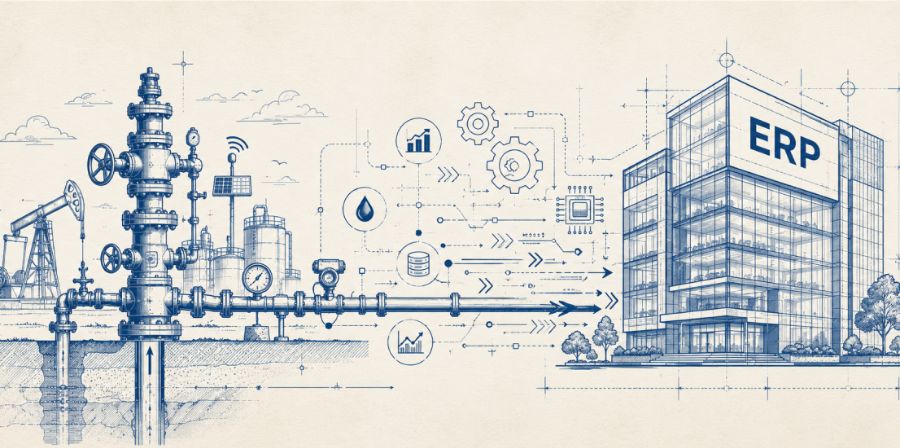
W Energy software connects to ERPs by acting as the source of truth for operational and accounting data across upstream and midstream oil and gas operations, then passing clean, validated financial data into the ERP through structured integrations. Production volumes, joint-interest details, and accounting entries are captured and reconciled inside Stream+ first, so what reaches the energy ERP balance sheet is already accurate and ready for reporting. The result is a single flow from the wellhead to the general ledger, without the duplicate records and manual re-keying that slow most teams down.
Why ERP Integration Is a Critical Challenge in Oil & Gas Technology Stacks
Oil and gas companies run on data that a generic ERP was never built to handle. A typical operation tracks well-level production, division of interest, marketing settlements, severance taxes, and gathering arrangements that change month to month. A standard ERP can post a journal entry and cut a check, but it has no native concept of a wellhead, a measurement point, or a gas imbalance.
That gap forces a choice. Either you stretch the ERP to do things it was not designed for, or you bolt on spreadsheets to fill the void. Both create the same problem: two or three places where the same number lives, and no clear answer for which is right. An oil and gas ERP strategy works only when the system handling daily operations and the system handling accounting share one definition of the truth, with data moving between them in a controlled, repeatable way.
The Role of Specialized Oil & Gas Software in an ERP-Centric Environment
This is where purpose-built software earns its place. Stream+ from W Energy handles the parts of the business a general ledger cannot: production allocation, division orders, revenue and severance calculations, and joint-interest billing. Stream+ can import field volumes directly into the accounting system, connecting production data with financial records, and its CalcTrace feature keeps revenue calculations transparent and traceable so you can see how every result was derived. For midstream operators, that same connection runs from real-time measurement into plant and pipeline accounting, with automated validation catching losses and discrepancies before they reach the books. W Energy’s Stream+ platform connects field data to finance so the numbers your accountants work with reflect what actually happened in the field.
Rather than competing with your ERP, specialized software complements it. Stream+ does the industry-specific heavy lifting and produces summarized, validated financial output. Your ERP then does what it does best: corporate consolidation, accounts payable, treasury, and enterprise reporting. Each system stays in its lane, and the handoff between them stays clean.
Common ERP Integration Models Used by Oil & Gas Companies
There is no single right way to connect operational software to an ERP. Most companies land on one of a few models, each with its own tradeoffs.
Batch File Transfer
The operational system exports summarized entries, often as a journal or trial balance file, on a set schedule. It is simple and easy to audit because every batch is a discrete, reviewable package. The tradeoff is timing; data is only as current as the last export.
API-Based Integration
Systems talk directly through application interfaces, pushing and pulling data on demand or in near real time. It keeps both sides current and cuts manual steps, though it asks more of your IT team to build and maintain.
Middleware and Integration Platforms
A dedicated layer sits between the two systems, mapping fields, transforming data, and managing errors. It scales well for companies with several connected systems, but it adds a component that has to be owned and supported.
The right choice depends on how fresh your data needs to be, how much IT capacity you have, and how many systems are in the picture.
Data Ownership, Controls, and Audit Trails Across Integrated Systems
When two systems share data, the first question worth answering is who owns what. A clean integration assigns each data element a clear system of record. Stream+ owns the operational and oil and gas accounting detail; the ERP owns corporate financials. To keep that arrangement consistent, Stream+ uses shared Global Business Associates and a common Chart of Accounts, which reduces duplication across the organization.
Controls keep the connection honest. Validation rules catch bad data before it crosses the boundary, so a mis-keyed volume or an out-of-balance entry never reaches the ledger. Real-time JIB reconciliation lets teams reconcile results in-app and rerun the process as needed, and every record that moves carries a timestamp, a source, and a user. That makes the platform a trusted, auditable source, and it turns answering an auditor or a partner into a matter of following the trail rather than reconstructing it.
How Poor ERP Integration Creates Hidden Costs and Operational Risk
A weak integration rarely fails loudly. It leaks. The first sign is usually duplicate records, where the same owner, well, or invoice exists in slightly different forms across systems, and nobody is sure which version to trust.
From there, the problems snowball. Broken workflows appear when a process assumes data that never arrives, leaving entries stranded. Month-end becomes a scramble to reconcile figures that should have matched automatically, and the close stretches longer each cycle. Teams quietly build spreadsheets to patch the gaps, and those become load-bearing systems no one documents. The costs are real even when they’re hard to see on a budget line: staff hours go to manual reconciliation instead of analysis, reporting errors create risk with partners and regulators, and decisions get made on numbers that are days old or simply wrong.
Use W Energy to Integrate Oil & Gas Operations with ERP Accounting and Reporting
Stream+ is W Energy’s purpose-built platform for upstream and midstream oil and gas, designed to sit at the center of your operational and financial workflows. For upstream teams, it brings revenue accounting, financial accounting, JIB, and division orders into one place. For midstream operators, the HighWire integration feeds real-time, validated measurement data straight into Stream+, catching discrepancies early and speeding the close. Built-in business intelligence through DataView gives every team the same validated data to act on. Because Stream+ links field operations to back-office accounting natively, the financial output it feeds your ERP is accurate, auditable, and ready for reporting.
How far you take that connection is up to you. Some operators integrate Stream+ with an existing ERP; others find that once operations and accounting already share one purpose-built platform, they need far less from a general ERP than they expected.
Request a demo today to take a closer look at how W Energy connects field operations to your ERP.