

Production Allocation vs. Hydrocarbon Accounting: What Upstream Teams Need to Get Right
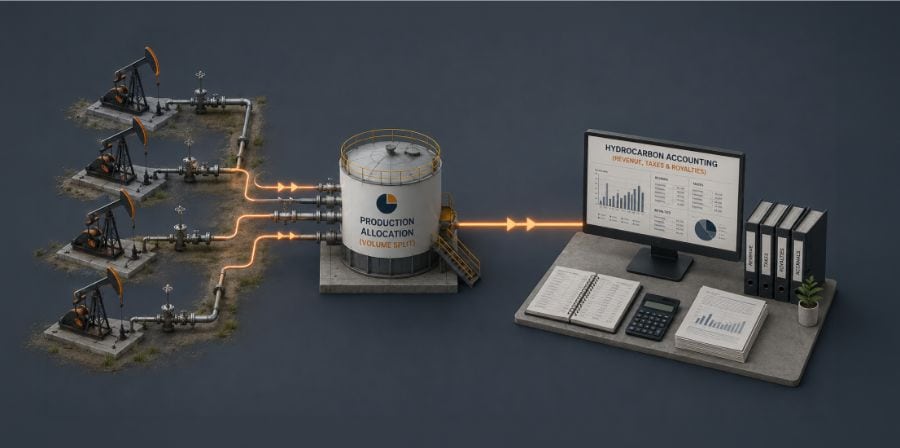
Production allocation decides how much volume each well and owner gets credited with, while hydrocarbon accounting takes those volumes and turns them into revenue, royalties, taxes, and financial statements. Allocation feeds accounting. When allocation is wrong, accounting is wrong too, and the errors usually surface at the worst possible time, during month-end close or when an owner questions a check. Getting the distinction right, and building controls around the handoff, is one of the highest-leverage things an upstream finance team can do.
What Production Allocation Is and Why It Impacts Revenue, Ownership, and Reporting
Production allocation is the process of distributing measured volumes back to their sources. A tank battery or central facility measures total production, but several wells, often with different owners and different working interests, feed into that point. Allocation answers a deceptively simple question: of the total measured volume, how much belongs to each well?
That number drives almost everything downstream. Revenue gets calculated on allocated volumes. Royalty owners get paid on their share of allocated production. Joint venture partners get billed and credited based on it. State regulatory reports pull from it. So a well that gets over-allocated by even a few barrels a day creates a chain of small payment errors that compound across owners and months. Allocation is the foundation that revenue, ownership accounting, and reporting all sit on.
Commercial Allocation vs Technical Allocation Explained
It helps to separate two kinds of allocation that often get lumped together.
Technical allocation is the engineering exercise of estimating how much each well produced, typically using well test data, theoretical capacity, and allocation factors to split measured volumes across sources. It answers what physically came from where.
Commercial allocation applies contracts and ownership to those technical volumes. It accounts for working interests, net revenue interests, percentage-of-proceeds arrangements, and the agreements that govern who is owed what. It answers who gets paid for it.
The two depend on each other. A flawless commercial calculation built on bad technical volumes still produces wrong payments. And a perfect technical split run through outdated ownership records also produces wrong payments. Both layers need governance, and they need to connect cleanly rather than living in separate systems that only talk through a spreadsheet.
Data Inputs that Break Allocation
Allocation is only as good as the data feeding it, and a handful of inputs cause most of the trouble.
Metering and custody transfer deltas are a common culprit. The volume leaving a facility, measured at the custody transfer point, often does not match the sum of what was measured upstream. Those discrepancies have to be reconciled and allocated somewhere, and if they are handled inconsistently, imbalances pile up.
Well tests drive technical allocation, and stale or late well tests quietly distort everything. If a well’s most recent test is months old and its actual rate has declined, the allocation keeps crediting it with volumes it is no longer producing, pulling volume away from wells that earned it.
Commingling, where production from multiple wells or zones combines before measurement, makes the split harder and more dependent on allocation factors. And shrink, the volume lost between the wellhead and the sales point through processing, flaring, or fuel use, has to be accounted for accurately, or the allocated totals will not tie back to what was actually sold.
How Allocation Errors Cascade into Revenue Distribution and Month-End Reporting
A single allocation error rarely stays small. Here is how it typically spreads.
An incorrect volume gets allocated to a well. That volume flows into revenue accounting, so the revenue figure is off. Royalty and working interest owners get paid on the wrong amount. The error appears in state regulatory filings. When someone catches it, often an accountant at 8am the day after close, a prior period adjustment is required, which means reopening processes, recalculating owner statements, and explaining the variance.
The cumulative effect is real. Manual spreadsheets used to patch allocation gaps introduce their own errors and leave no audit trail. Late well tests force reruns. Custody transfer deltas left unreconciled snowball into chronic imbalances. Each issue delays close and erodes confidence in the numbers, and finance ends up spending its time chasing corrections instead of analyzing results.
A Practical Allocation Governance Model for Upstream Accounting Teams
Controls do not have to be complicated. A workable governance model rests on a few habits:
- Validate before posting. Run allocations, review the result sets, and catch errors before they become revenue. Rerunnable processes make this realistic rather than aspirational.
- Set freshness rules for well tests so allocation flags stale inputs instead of silently using them.
- Reconcile custody transfer points on a defined cadence so deltas get resolved monthly rather than accumulating.
- Build automated range checks and exception rules at the point of data capture, so bad readings get caught in the field and not three systems later.
- Keep a complete audit trail, so every allocated volume and every adjustment shows who did what, when, and why.
The biggest structural improvement is connecting field data, allocation, and accounting in one environment. When allocation lives in one system and accounting in another, the spreadsheet bridge between them becomes the weakest link.
Improve Production Reporting Confidence with W Energy
W Energy’s Stream+ platform puts field operations, allocation, and back-office accounting under one roof. Allocated volumes flow straight into revenue, division orders, and JIB without manual transfers, and real-time allocations mean errors surface as data comes in, not the next morning.
Paired with our Upstream Accounting solution, teams get rerunnable monthly processes to validate results before posting and reduce prior period adjustments, plus CalcTrace transparency that shows exactly how every revenue figure was calculated. As an integrated oil and gas production reporting software, it gives finance teams confidence that the numbers tie back from the wellhead to the financial statements.
Request a demo to see how W Energy can improve your upstream operations.