

5 Best Practices for Implementing Oil and Gas Data Management Software
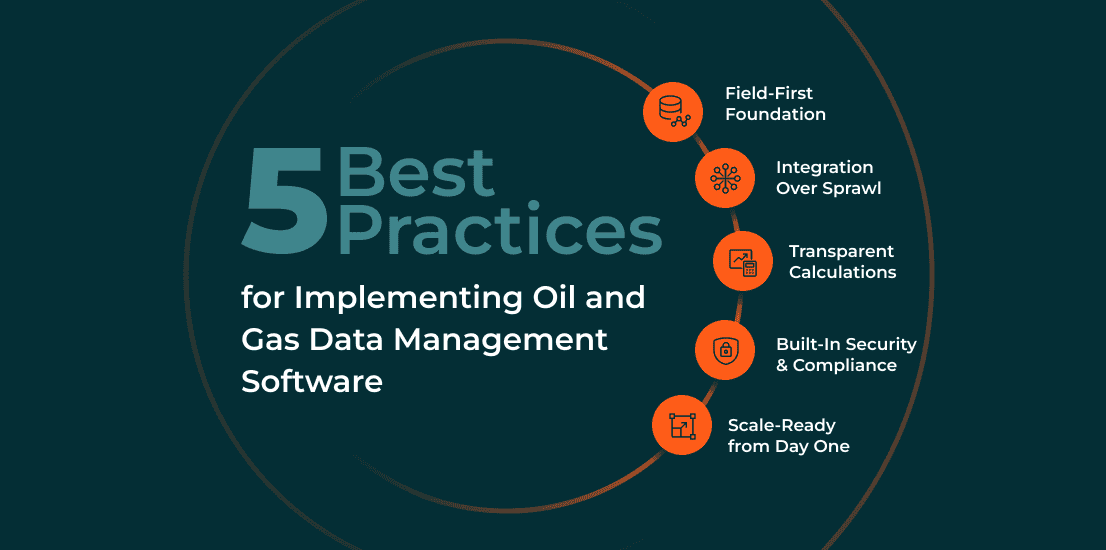
Successful data management software implementation in oil and gas comes down to five fundamentals: choosing a platform purpose-built for the industry, prioritizing integration over isolated tools, validating data at the source, planning for security and compliance from day one, and selecting solutions that scale with your asset portfolio. Upstream and midstream operators who get these right see faster month-end closes, cleaner allocations, fewer prior period adjustments, and meaningful gains in bottom-line value.
Getting there takes more than buying software. The companies that win are the ones treating implementation as a strategic project rather than an IT checkbox, with clear ownership across field, accounting, and leadership teams. The recommendations below come from what actually works for energy operators managing complex assets.
1. Start with a Field-First Foundation
Data quality lives or dies at the point of capture. If your lease operators are juggling five apps to log production volumes, run tickets, and compliance checks, errors creep in long before anyone tries to run allocations or reports. Operators using fragmented systems can spend up to two hours a day on data entry alone, and accountants often discover problems the next morning when it’s already too late to fix them cleanly.
A better approach unifies field data gathering, field service management, and production accounting on one platform. Look for mobile tools with built-in validation rules, min/max range checks, and offline capabilities for remote sites. Real-time sync matters because allocations should trigger the moment enough data comes in from the field or SCADA, not the next morning.
2. Prioritize Integration Over Best-of-Breed Sprawl
Oil and gas teams often inherit a patchwork of point solutions: one tool for AFE management, another for land, and more for production accounting, general ledger, and revenue distribution, plus spreadsheets to cover the gaps. Each integration becomes an IT project costing hundreds of thousands of dollars and taking six to eight months.
The better path is a platform where land data flows into accounting, production volumes flow into allocations, and AFE actuals tie back to budgets without exports or reformatting. When evaluating vendors, ask how their modules share data natively. Ask whether you can maintain a single global chart of accounts and business associate list across companies. Also, ask whether contracts, division orders, and revenue calculations sit in the same environment. Frictionless integration is what cuts month-end from days to hours.
3. Make Calculations Transparent
One of the most overlooked best practices is calculation visibility. When a partner disputes a settlement value or an auditor asks how a number was derived, your team should be able to trace every variable, formula, escalation, and rate that produced it. Tools like CalcTrace give that step-by-step view, which builds trust with partners and dramatically shortens dispute resolution.
Transparency also protects you internally. Accountants who can validate results before posting catch errors early and reduce prior period adjustments down the road.
4. Build Security and Compliance In from the Start
Cloud-based platforms have become the standard for good reason, but security planning still belongs at the front of any implementation. Confirm SSO integration, admin-controlled roles and permissions, and attribute-level auditing. Audit trails matter enormously for regulatory reporting and for limiting risk associated with work done outside the system in spreadsheets.
For state-level compliance, verify that your software handles the regulatory reports your basins require, from Texas RRC PR to Colorado Form 7 to North Dakota Form 5. Tax calculations vary by state, and a platform with that logic already built in saves your team from manual workarounds.
5. Plan for Scale Before You Need It
Acreage grows. Asset portfolios consolidate. M&A activity in oil and gas has been running at record levels, with over $250 billion in transaction value across a recent twelve-month period. Your data management software needs to grow with you, not against you.
Scalability shows up in practical ways. Can you add new assets without spinning up parallel systems? Can you rerun monthly processes quickly when source data changes? Can you handle prior period adjustments going back several months without delaying the current close? A scalable data model also makes you ready for buy-side or sell-side activity. When your land records, financials, and production volumes live in a unified database, building a data room becomes a straightforward task rather than a months-long fire drill.
Simplify Oil and Gas Data Management with W Energy
W Energy’s purpose-built platform was designed around the realities of upstream and midstream operations. Our DataView business intelligence solution sits inside the same environment as accounting, land, production, and field service, giving teams access to expert-level analytics without needing data specialists on staff. We aggregate data from multiple sources into one platform, normalize it automatically, and support leading BI tools like Power BI, Tableau, and Spotfire so teams can keep working with what they already know.
The result is faster time to insight, fewer departmental silos, and a single source of truth from field to finance. Our customers see month-end processing in hours instead of days, with allocation speeds 150 times faster than the industry average.
If you’d like to see how W Energy can streamline your data management, request a demo today.